
Loading...
Loading...
Ammunition is the heart of every firearm. Its design, size, and composition determine accuracy, power, and performance. Knowing how different ammunition types work helps shooters make informed decisions and maintain safety at the range or in the field.
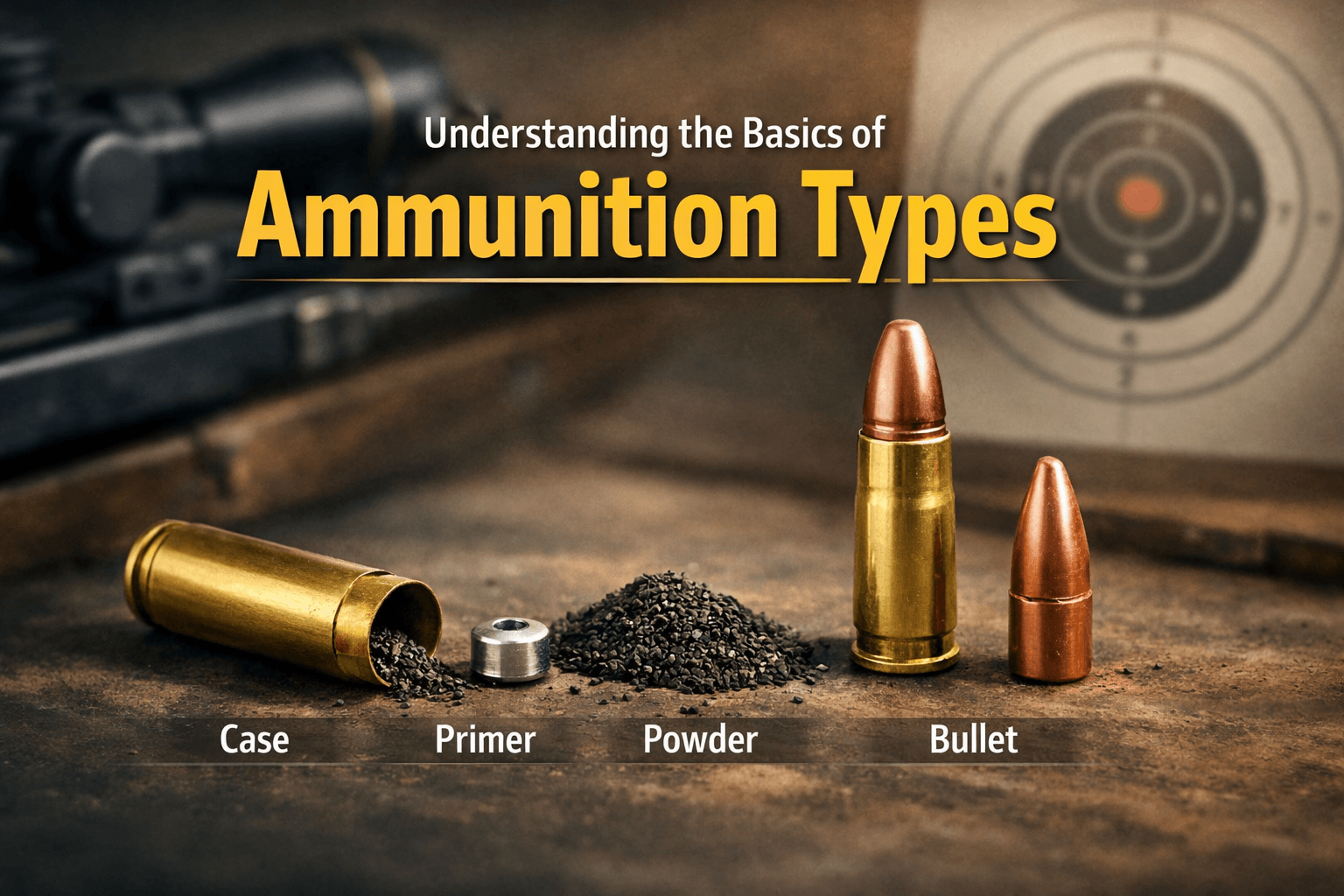
Ammunition refers to the cartridges or shells loaded into firearms. Each round contains several essential parts that work together when the trigger is pulled. These parts are:
Case – The container that holds all components together.
Primer – The ignition source that starts the firing process.
Powder – The propellant that generates gas pressure.
Bullet or Projectile – The portion that exits the barrel toward the target.
The quality and compatibility of these parts affect how a firearm performs. Using the right ammunition is vital for precision, reliability, and safety.
Different firearms require unique ammunition specifications. Here are the main categories:
Handgun rounds are shorter and often measured in calibers. Common examples include:
9mm Luger – Popular for self-defense and law enforcement.
.45 ACP – Known for stopping power and slower velocity.
.380 ACP – Compact and easier to handle, often used in concealed-carry pistols.
Handgun ammo is made for manageable recoil and rapid firing at short ranges.
Rifle ammunition is generally more powerful, designed for higher velocity and long-distance accuracy. Common types include:
.223 Remington / 5.56 NATO – Widely used in semi-automatic and AR-style platforms.
.308 Winchester – A versatile round suited for hunting and target shooting.
.30-06 Springfield – Known for its ability to balance range, power, and accuracy.
Rifle rounds vary significantly in size, shape, and ballistic performance.
Shotgun shells differ from handgun or rifle ammunition because they fire multiple small pellets (shot) or a single slug. They’re primarily used for hunting, sport shooting, and home defense.
Common gauges include:
12 Gauge – The most common, adaptable for many applications.
20 Gauge – Lighter recoil, useful for smaller game.
.410 Bore – A small shell for beginners or low-recoil shooting.
Some ammunition does not fit into the usual categories. Examples include blanks used for training, dummy rounds for dry-fire practice, and frangible bullets designed to disintegrate on impact for safety in close-quarters training.
Caliber refers to the internal diameter of a firearm’s barrel and the corresponding diameter of the bullet. It’s often measured in inches or millimeters (for example, .22 or 9mm).
Small-caliber ammunition tends to have lower recoil and lighter bullets, while larger calibers offer increased impact force and range.
| Caliber | Common Use | Firearm Type |
|---|---|---|
| .22 LR | Target practice, small game | Rifle, Handgun |
| 9mm | Self-defense, duty carry | Handgun |
| .223 Rem | Sport shooting, varmint hunting | Rifle |
| .308 Win | Big game hunting, precision shooting | Rifle |
| 12 Gauge | Bird hunting, home defense | Shotgun |
Understanding caliber helps ensure proper ammunition selection and reliable firearm performance.
Bullets come in a range of designs, each built for a different purpose.
Full Metal Jacket (FMJ) – Features a lead core covered by a copper jacket; ideal for practice and training due to consistent flight patterns.
Hollow Point (HP) – Expands upon impact, improving stopping effectiveness in defense situations.
Soft Point (SP) – Partially exposed lead tip for controlled expansion, useful for hunting.
Ballistic Tip – Combines aerodynamics with expansion, often used by hunters seeking accuracy and terminal performance.
Each design affects how the bullet penetrates, expands, and transfers energy upon impact.
Ammunition is also categorized by primer location.
The primer compound is built into the rim of the casing. When struck, it ignites the powder inside. Rimfire rounds like .22 LR are affordable and ideal for practice and small-game hunting.
The primer sits at the center of the cartridge base. This design supports higher pressures, better reliability, and reloading capability. Most modern handgun and rifle calibers are centerfire.
Modern cartridges include a mix of metals and chemical compositions that influence performance.
Cases – Usually brass for durability and corrosion resistance, though steel and aluminum are also common.
Primers – A mix of chemical compounds that spark ignition upon strike.
Propellant Powders – Smokeless powders control burn rate and pressure.
Bullet Jackets – Often copper, which reduces barrel fouling and enhances accuracy.
Material choice can also affect cost and reusability.
Ammunition boxes and casings are marked to help shooters identify the correct caliber. Common designations include caliber, bullet type, and manufacturer codes. For example, “.223 Rem 55gr FMJ” indicates a .223 caliber, 55-grain bullet, and full metal jacket design.
Always verify that ammunition matches the markings engraved on your firearm’s barrel or slide.
Proper storage extends ammunition shelf life and preserves effectiveness. Follow these guidelines:
Keep ammo in a cool, dry location.
Store in airtight containers or ammo cans with desiccant packs.
Avoid exposure to extreme temperatures or moisture.
Label containers with caliber and purchase date.
Keep ammunition separate from firearms, especially in homes with children.
Well-maintained ammunition functions reliably even after years in storage.
Many firearm malfunctions stem from incorrect or mismatched ammo. Key points to remember include:
Never mix calibers or gauges.
Inspect ammunition before loading, discarding rounds with dents, corrosion, or deformities.
Use ammunition recommended by the firearm manufacturer.
Avoid reloaded rounds from unknown sources unless verified safe.
Attention to detail ensures safety and consistent shooting performance.
Choosing the right ammunition means more than matching caliber numbers. It builds confidence and precision while protecting the shooter and firearm. Understanding cartridge components, bullet styles, and safety considerations helps every gun owner shoot smarter and safer.